

TENZAN AIKIDO NEWSLETTER
One Heart, One Mind
For the last five months (after 13 years of practice) I have been training intensively in aikido, sometimes for 3 hours a day, often 6 days a week. It’s been a very physical training on the one hand and yet my progress has depended also on my spiritual development. The two (physical and spiritual) cannot be separated: drilling is vital not only to learn the techniques, but just as importantly, to embody the ideas. It has involved rigorous work-outs, a lot of sweat, some blood and a few tears. The superficial result has been greater stamina, a feeling of being ‘in shape’, a little weight loss, and bigger muscles. I’ve also managed to plough my way through uncountable hand-to-hand techniques and their variations…
So what have I learnt? (By the way, when I write ‘he’, ‘him’ and ‘himself’, I’m referring to my partner/attacker who may also be ‘she’, ‘her’ and ‘herself’).
- Take the lion’s share
- Take up the space, fill the void
- Let the beast out
- Don’t pull back into yourself. Plant his forehead into the mat (suwariwaza nikkyo)
- Don’t worry about your partner. He can take care of himself
- Put the weight of your presence into your hands
- Lift your gaze. Don’t look down. Have a vision.
- Don’t be mesmerized by the knife. Look at your partner. He’s not just a hand. Stay connected to him.
- Everything is about placement and timing
- Do ikkyo as if your life depended on it – because it does
- Don’t let up. Don’t give your partner the chance to regain his balance. He was the one who chose to attack you. He invaded your space.
- Don’t take care of your partner. Don’t make him comfortable at your own expense.
- Don’t let anything rattle your cage
- Don’t be drawn into another’s world. Ground yourself
- Be like an ape, an ugly big gorilla. Don’t be polite.
- Make every movement purposeful. This is not choreography.
- Going slowly doesn’t mean ‘dreamy’. Wake up! Engage!
- Move him around your belly – you need a big Buddha belly.
- Look – just kick him in the mozzarella
Making a list of things sensei has been saying to me repeatedly is revealing. My private lessons were so much about me and as I faced some of these demons, so my technique improved. I not only faced my demons but learned how to face them down. In that fierce gaze, they shrivel up and disappear. Yes, they come back, but any power I gave to them is gradually waning.
This essay would be very long if I wrote about each of these statements – and there is a tale to tell about every one of them. Every single one went straight to the heart of things, affecting me profoundly. Physically this is what I needed to do (except the mozzarella one). Psychologically these were difficulties I’ve always had in relation to others. Spiritually they were, and continue to be essential for fresh perspectives, wider horizons, renewal and transformation.
One of the most significant ideas for me is the notion of maintaining connection and ‘getting in close’. When I am tempted to hold myself away and separate myself from another, I am less effective, more vulnerable and more likely to cause pain to myself as well as my partner. My upbringing taught me to be prim, modest and polite under all circumstances, which in some ways bred a certain timidity or hesitation in coming forward. How freeing it is to get close, deflect a blow, grab someone’s elbow and bring them firmly to the floor. Raaarrr!
A frequent difficulty I had, particularly earlier on in this training period, was in bending my knees and lowering my center. My knees felt as if they would buckle if I bent them and occasionally they did. I figured out that I could more comfortably bend my knees by tilting my pelvis forward and expanding my belly. But it wasn’t until it occurred to me that I needed to think about the meaning of ‘yielding’ that one day, I spontaneously began to bend my knees, lower my center and feel strong and stable at the same time. It wasn’t an intellectual exercise to change my personality, rather, yielding became an actual sensation of spaciousness and timelessness within me; a state of ego-less ‘no-mind’ which invited my body, me, to respond naturally and appropriately. There is still so much more to learn about this kinder, gentler approach to my learning.
What I love about aikido is that it is impossible to do it alone. This is not a solitary pastime or endeavor. Though it is about individual growth, it’s always in relation to another and we find that we can’t do it in isolation. To heal as individuals we have to include everyone. As I change and shift my view of myself, others appear to change and so does the world I live and move in. I literally begin to feel connected and supported in my world and begin to relate to it and others in a healthy, wholesome way.
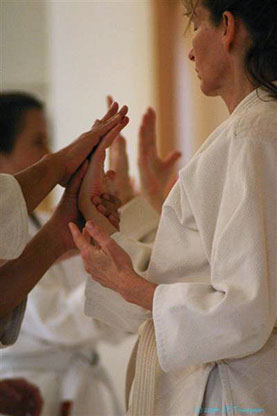
The more I train in aikido the more I learn about how to be present, which means that, when present, my intention is clear, I am focused, purposeful, grounded and centered, and my movements – and life – will reflect all of that. On the mat, my hands have weight and intention, giving clear direction to my attacker and engendering in him a sense of trust and safety, being truly seen and calmly met. Such an encounter is an act of reconciliation, not violent subjection, and lifts the attacker to a better sense of himself – to resolution and healing. Presence is being in the moment, and as somebody said, ‘rooted in reality, where there is no fear, only love’.
My training in aikido has demanded an enormous commitment from me in terms of focus, vision, courage and persistence and I’ve learned how vital these qualities are to success in every part of life. It has also proved to be a joyful expression of resonance and power. O’sensei called aikido the ‘art of peace’ and the ‘power of love’. I have the smallest inkling of what that means, but I am inspired by his words: ‘aiki…is the way to reconcile the world and make human beings one family.’ and ‘true budo (spiritually oriented martial art) is to be one with the universe, that is, to be united with the center of the universe.’
Aikido wakes me up so that I can claim my one-ness with the universe and find that I have the strength and willingness to live it out every moment.
Bridget Thompson,
Shodan Essay, 6 March, 2012